Minesweeper
Minesweeper without guessing — a journey, a daily board, and the classic.

Minesweeper without guessing — a journey, a daily board, and the classic.
Every board in this app can be solved without guessing. Before a board is offered, the app solves it from its glowing start cell to the end by logic alone, and only boards that can be solved that way are kept. On top of that there are three ways to play: a journey where each world twists the rules, a daily board that gets harder through the week, and the classic you came for.
No subscription, no account. Your games and records stay on your phone.
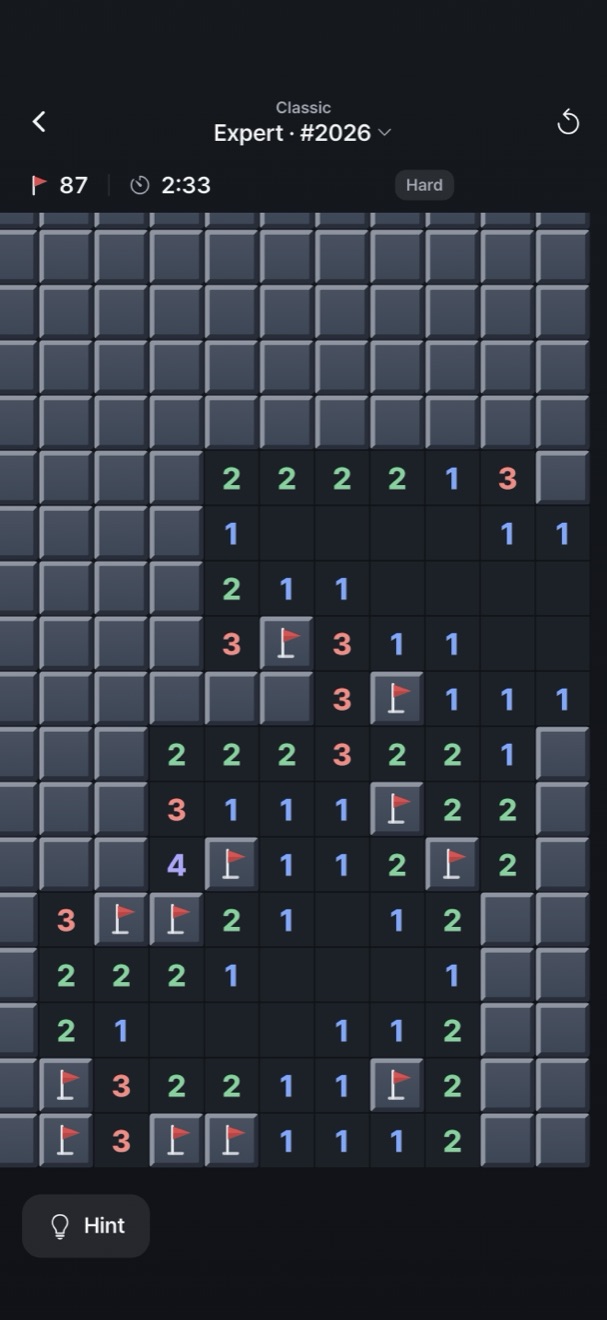
Beginner 9×9 with 10 mines, Intermediate 16×16 with 40, Expert 16×30 with 99. Expert stands upright — a phone is held that way, and lying sideways the cells would be half a finger wide. Cells stay finger-sized and large boards pan.
100,000 numbered boards per size, the same on every phone. Before you open a cell, the header shows how hard the board is — Easy, Medium, Hard or Very hard — rated by the reasoning it needs, not its size.
Cells are drawn as the raised squares of classic Minesweeper. A cascade flows the way the empty cells connect, and every cell you open plays the next note of a scale, so steady play becomes a little melody.
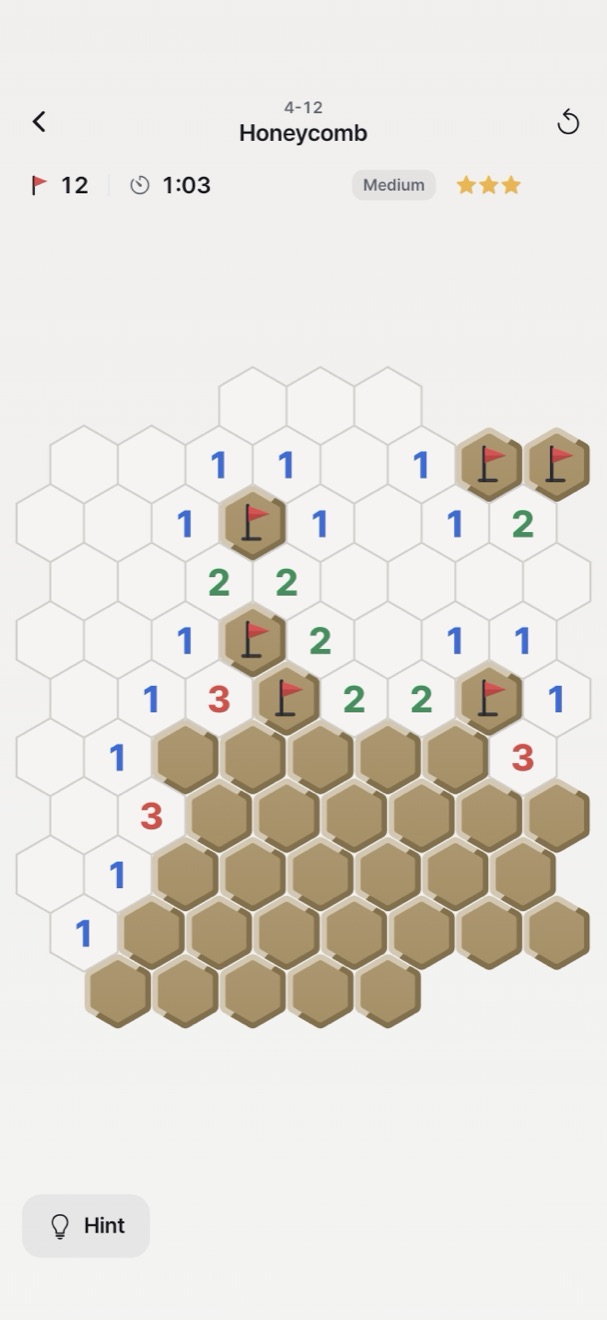
Each new rule is shown first on a tiny example board. Hold an open number on any board to see exactly which cells it counts.
Even with twisted rules, every board is guess-free. A number always says "this many mines among these cells"; a twist only changes which cells. There is one solver, tested against every possible arrangement for each rule.
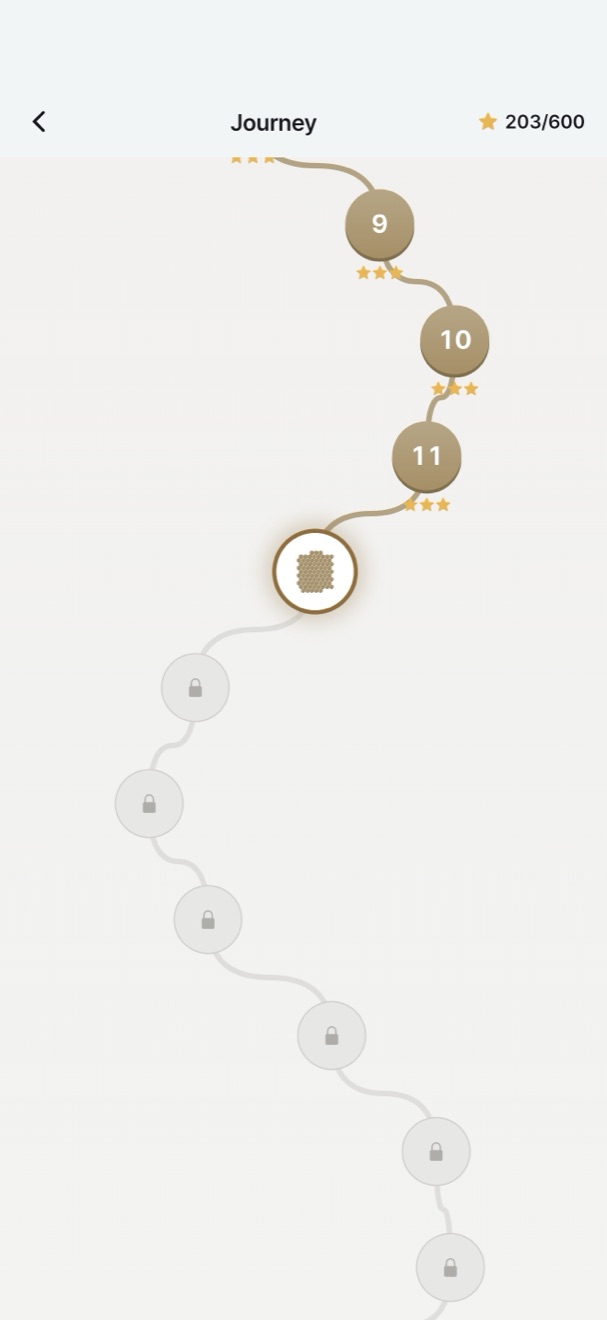
Follow the winding path one board at a time. Each world brings one new thing — the first three teach a way of reasoning (one number, two numbers together, counting the mines left); after that, the rules themselves start to twist.
Three stars on each board — clear it, no hints or mistakes, beat the time. But stars never block your way: clear a board and the next one opens.
The first three boards of the Meadow are guided. The board points to your next move by itself, and a bubble above it says what to do and why.
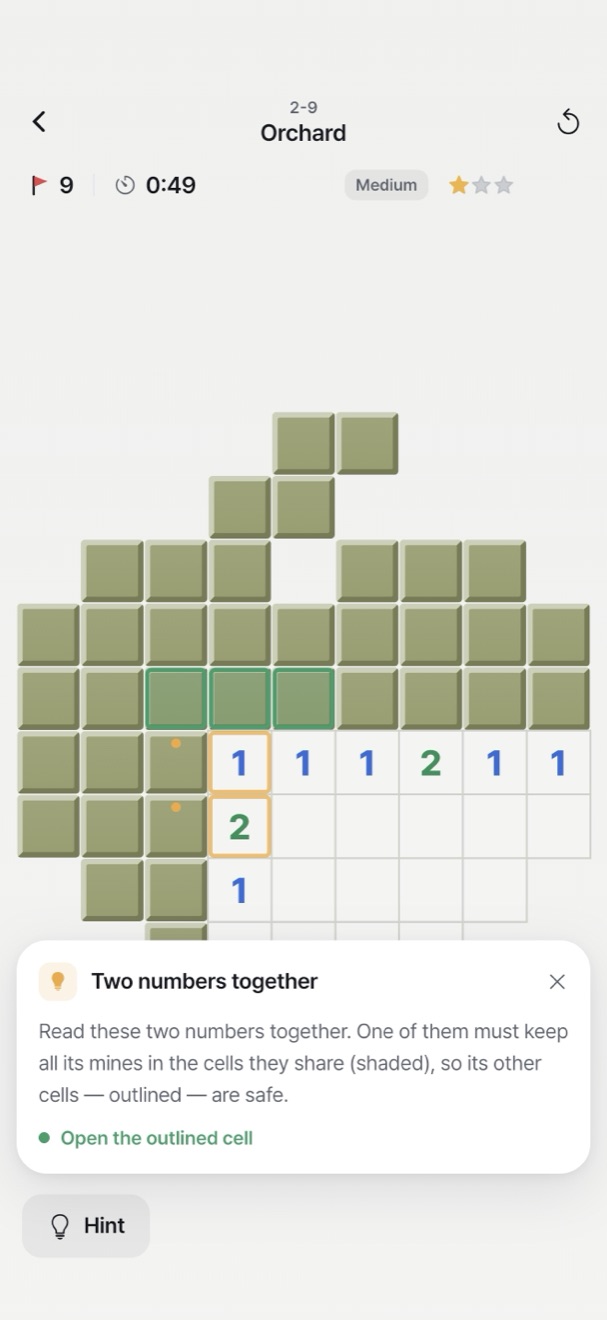
Most hints just reveal a safe cell, and you're stuck again on the next board. Here, a hint points to the numbers that decide it and says in one sentence which reasoning it took.
Read these two numbers together. One of them must keep all its mines in the cells they share (shaded), so its other cells — outlined — are safe.
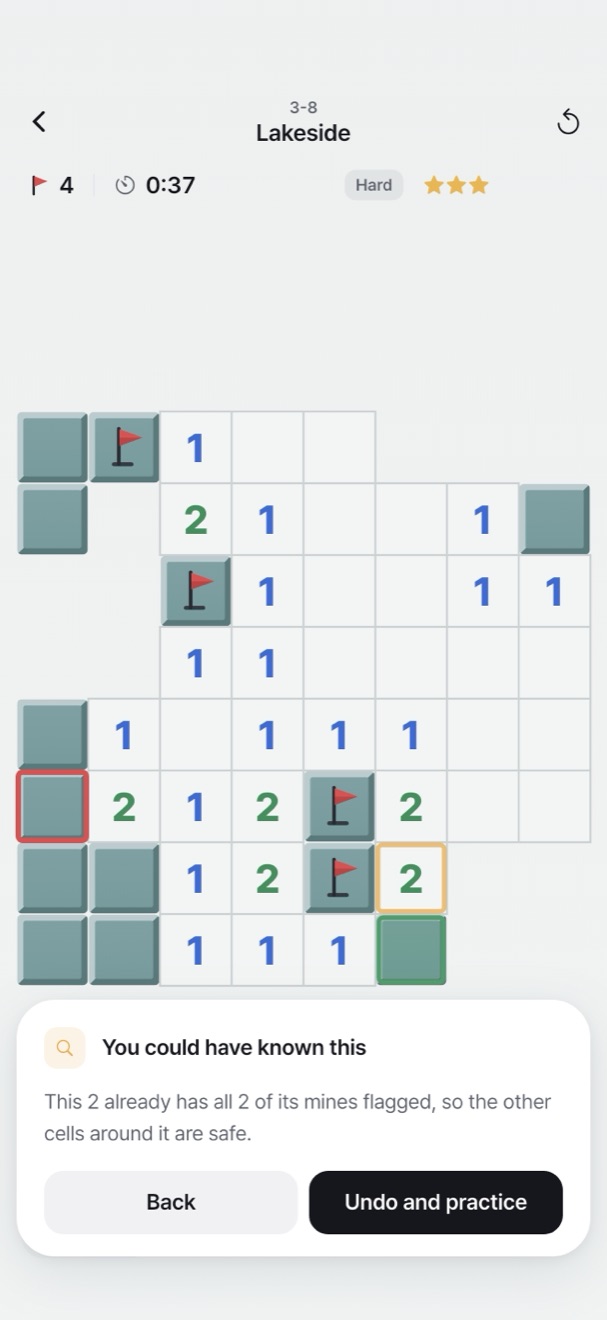
Step on a mine and the board is over — even if the numbers had already given it away. Then "Where?" shows the board just before your move, with a cell you could have known and why. It also tells you whether you guessed or the numbers had already shown the mine.
You can play on from just before the losing move; clear it that way for one star.
Tap opens, hold flags. A press in between does nothing, so lifting a little early while flagging never opens a cell. The flag lands with a buzz before you lift your finger. You can switch to tap-to-flag · double-tap-to-open, or a dig/flag switch, and choose the hold time.
We shook 20,000 test presses around the edges of a tap and a hold. None opened a cell it shouldn't have.
One board a day, the same for everyone. Easy on Monday, harder each day, and on Sunday two rules combine. Share your stars and time in one line.
Minesweeper · Daily Oct 19
★★★ · 3:12.4
Cleared days show as stars on the Records calendar, with your days in a row. If you missed a day, you can still play it. Tap an earlier day of this month with no win on the calendar and watch one ad to open that day's board. Clear it and the day is filled, counting toward your days in a row like any other day.
There is one place an ad can appear: when you tap a missed day on the Records calendar and choose to watch one ad to play that day's board — only if you choose to. There are no ads while you play or between boards.
Free. There is nothing to buy in the app.
Your games and records stay on the phone. There is no account. The app sends usage statistics to see how it is used — see the privacy policy.
iPhone, iOS 15 or later. In English, Korean, Japanese, German, French, Spanish, Portuguese and Chinese (Simplified and Traditional).